
Listen to this content
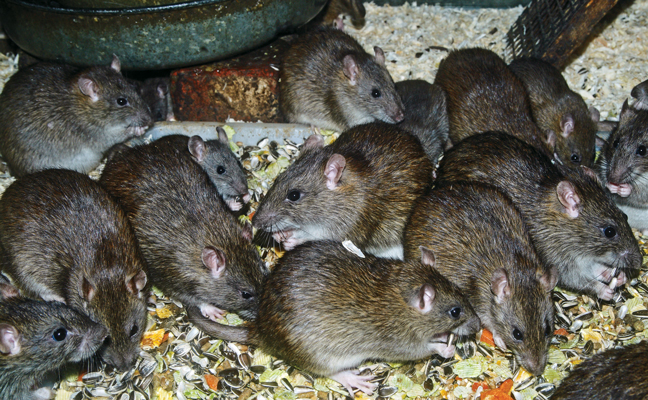
Every school site requires a custom plan, which begins when the pest management professional (PMP) gathers data on existing rodent pressure. The resulting initial assessment not only tracks and locates pest activity but also ensures the corrective actions directly match the specific responsibilities of everyone involved in the IPM program.
Key assessment elements include:
- Proper species identification: This ensures success for the entire IPM program. PMPs must interview staff to collect details about previous treatments and known infestations to establish a comprehensive look at the situation at hand.
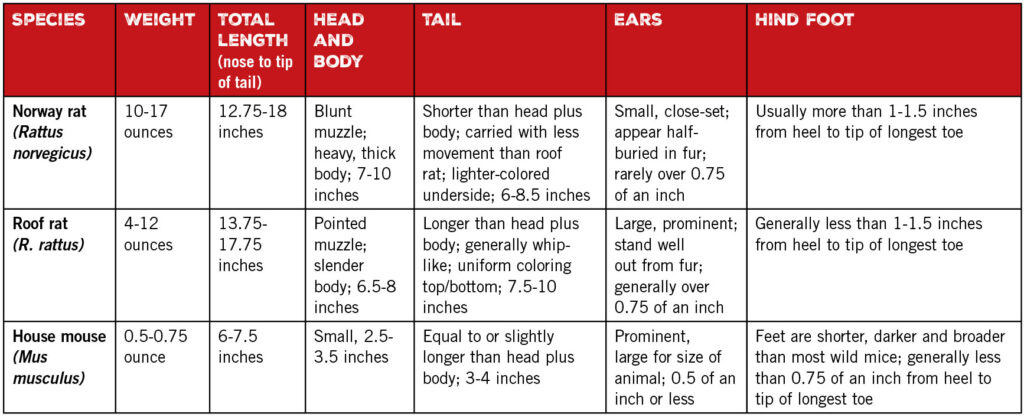
- Distinguishing traits: Knowledge of weight, total length, tail proportion and ear size helps PMPs and school facility staff quickly distinguish among house mice, Norway rats and roof rats. This allows for targeted, effective corrective actions tailored to each species’ characteristics.
- Systematic inspections: This involves carefully scrutinizing the environment for signs of rodent activity, identifying all potential entry points and pinpointing vulnerable areas. By implementing regular, routine checks guided by a comprehensive checklist, PMPs can guarantee early detection and deploy immediate, targeted control measures.
Structured inspection calendar:
- Monthly checks: For high-traffic areas such as kitchens, cafeterias, classrooms, lounges, custodial closets, basements, dumpsters and loading docks.
- Quarterly inspections: For roof voids, attics, suspended ceilings, locker rooms, gyms, boiler rooms, utility chases and athletic fields.
- Annual review: To assess historical activity, update trap schematics and adjust service frequency.
Typical rodent hotspots: Hotspots include kitchens, cafeterias, vending machines, storage rooms, classrooms, locker rooms, gyms, mechanical rooms, basements, utility chases, ceiling voids, attics, exterior dumpsters, foundation plantings, playgrounds and athletic fields near fences. Norway rats, in particular, may enter from sewers or dig burrows from the exterior.
Best practices for inspection:
- Examine both indoor and outdoor environments for droppings, gnaw marks, runways, burrows, odors and sounds.
- Prioritize pest-vulnerable areas and check for structural vulnerabilities, including gaps, cracks, broken windows, compromised vents and floor drains.
- Use specialized tools to aid detection: flashlights; ultraviolet (UV) lights to reveal urine, droppings and rub marks; dust tracking for runways; thermal cameras for body heat; and borescopes for inside walls and ceilings.
- Inspect and maintain door sweeps and weather stripping quarterly, replacing damaged or worn components.
- Document findings using checklists to ensure all rodent hotspots are monitored consistently.
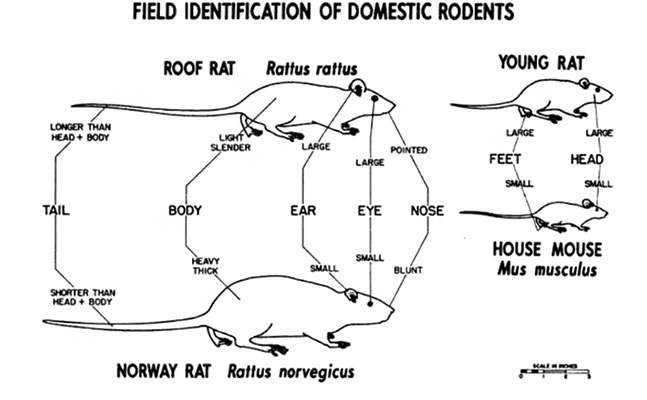
Information adapted from Brown, R.Z. (1960). “Biological factors in domestic rodent control (No. 773).” US Communicable Disease Center
Ongoing monitoring: Monitoring is essential for tracking rodent activity, evaluating control measures and guiding timely interventions.
- Check traps and bait stations regularly (daily, weekly or as needed).
- Record locations, dates, rodent types and actions taken.
- Use a standardized zero-to-5 scale to measure severity and trends.
- Record signs of activity: when, where and how many droppings, gnaw marks, rub marks, nests and burrows.
- Deploy remote monitoring devices in hard-to-reach areas (ceilings, wall voids).
- Ensure all traps and devices are tamper-resistant and inaccessible to students, staff and pets.
- Set action triggers using activity thresholds to guide additional control measures.
- Share results with school staff regularly to support accountability.
2. Elimination
Eliminating rodents in schools requires a multi-pronged approach that prioritizes safety, long-term control and effectiveness. This includes trapping with snap traps, multi-catch traps, glue boards and, when necessary, the appropriate use of rodenticides in secure, tamper-resistant stations.
Best practices for rodent treatment include:
- Outdoor use is preferred: Place rodenticides in secure, tamper-resistant bait stations along exterior foundations.
- Restrict indoor use: If necessary, use only in tamper-resistant stations located in areas inaccessible to students and staff, such as locked cabinets, crawlspaces or behind equipment.
- Place materials strategically: Position traps and bait stations near fresh droppings, rub marks and active runways. Find spots along walls, in corners, or behind appliances.
3. Coordination
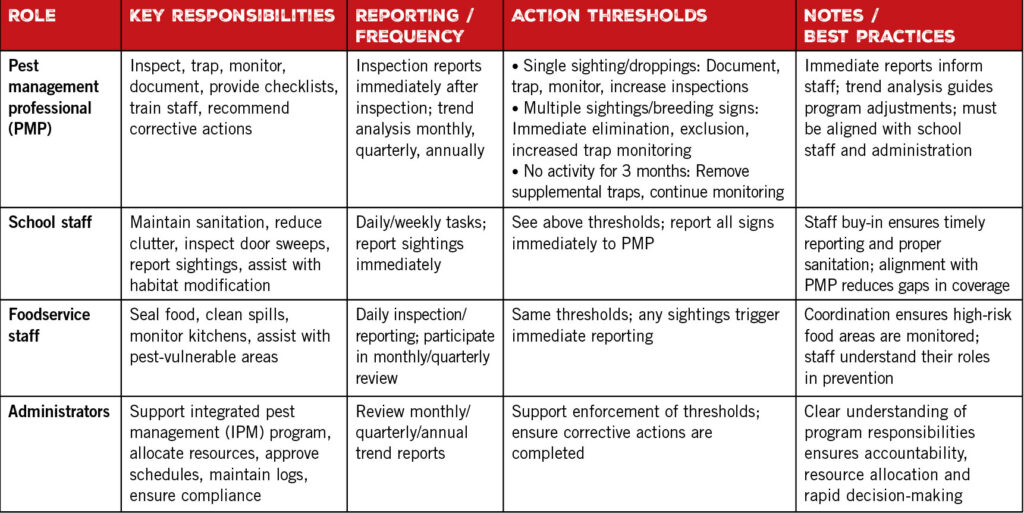
Effective rodent management requires alignment, shared responsibilities and agreed-upon actions. All roles, responsibilities and thresholds must be agreed upon and formally accepted by stakeholders to ensure transparency, accountability and rapid outcomes.
4. Keeping records
Accurate record-keeping is essential for effective rodent management, enabling trend analysis, accountability and informed decision-making.
- Maintain detailed records of captures by date and location.
- Document the placement of traps, bait stations and monitoring devices.
- Record observations of rodent activity, environmental conditions and any corrective actions taken.
- Track communication with school staff and assign responsibilities to ensure follow-up actions are completed.
5. Prevention
Prevention focuses on eliminating rodent access, food and shelter through three strategies:
Exclusion:
- Seal gaps that are 0.25 of an inch or above with concrete, sheet metal or hardware cloth.
- Inspect and maintain door sweeps and weather-stripping.
- Repair broken windows, doors and screens; seal vents and floor drains.
Sanitation:
- Rodent-proof food storage and clean spills promptly.
- Empty trash daily and keep dumpsters at least 75 feet away from building entrances.
- Reduce classroom and storage clutter.
- Remove neglected food sources, including spilled grain or dead insects.
Habitat modification:
- Trim shrubs and trees and maintain a gravel strip along building foundations.
- Remove climbing plants and vines that provide access.
- Repair leaks and eliminate standing water to remove moisture sources.
Sidebar: Rodents by season
Rodent activity varies seasonally, so inspection priorities should adjust accordingly:
- Winter (December, January, February): Rodents remain active indoors, so continued trap monitoring and inspection of pest-vulnerable areas is critical.
- Spring (March, April, May): Outdoor breeding activity begins, requiring attention to dumpsters, landscaped areas and roof or attic spaces.
- Summer (June, July, August): Outdoor populations increase, emphasizing sanitation, vegetation maintenance and strategic placement of exterior traps.
- Fall (September, October, November): Indoor invasions peak, making it essential to seal gaps, inspect door sweeps and monitor traps.
Dr. Mohammed El Damir is the technical and training director for Adam’s Pest Control, Medina, Minn. and an online columnist for PMP. He can be reached at PMPEditor@northcoastmedia.net.