
No audio available for this content.
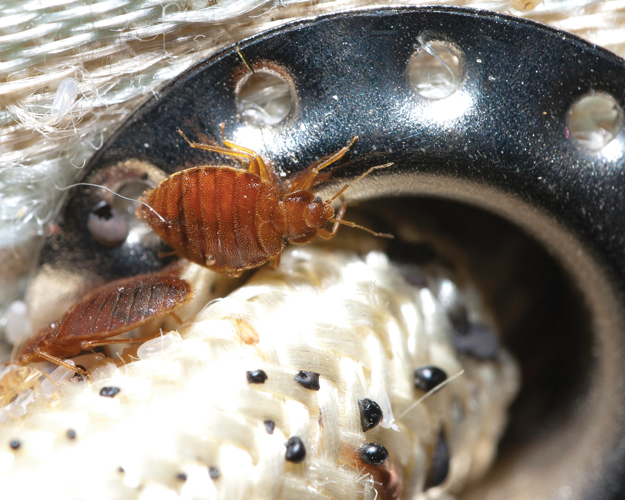
Bed bugs remain a persistent challenge thanks to their hiding behavior, insecticide resistance and rapid reinfestation. They conceal themselves in cracks, furniture and clutter, making detection and elimination difficult. Increasing resistance to common insecticides compounds the challenge.1
Infestation levels are influenced by multiple factors, including the bugs’ hiding behavior, human reintroduction, chemical resistance, host availability and environmental conditions such as humidity and temperature. Understanding these factors is essential for planning effective, long-term control programs.
Chemical treatments
Bed bugs have developed resistance to multiple insecticides, including some fipronil1 and pyrethroid2 formulations. Over-reliance on a single chemical can fail, making rotation and integration with other methods essential. In addition, high humidity or steam exposure can negatively affect some dusts.3 Thus, chemical application best practices include:
▶ Avoid dust application in humid areas without adjustments.
▶ Combine dusts with heat or supplemental nonchemical methods.
▶ Expect some resistant strains to survive some chemical treatments.
Heat treatment
Bed bug heat treatment is a rapid, nonchemical approach for large infestations or pesticide-resistant populations. It complements chemical and supplemental methods. A 2011 study4 determined the optimal temperatures and exposure times needed to kill adults and eggs:
▶ At 113 degrees Fahrenheit, bed bug death occurs after approximately 95 minutes. Nearly all adult bed bugs die at 118.4 degrees Fahrenheit.
▶ Bed bug eggs are more heat tolerant. They can survive up to seven hours at 113 degrees Fahrenheit. At 118.4 degrees Fahrenheit, eggs are killed after approximately 72 minutes.
Because heat treatment alone leaves no residual protection, follow up with monitoring and chemical treatment as appropriate.
Additional methods
Some interventions do not rely on conventional insecticides but strengthen integrated strategies:
▶ Mattress encasements. Fully cover mattresses and box springs to block bed bugs and simplify monitoring.
▶ Clutter reduction. Remove items around beds and furniture to limit hiding spots and improve treatment effectiveness.
▶ Supplemental biopesticides. Products containing Beauveria bassiana or plant-derived essential oils can help reduce bed bug populations but work best as part of a comprehensive integrated pest management (IPM) program.5, 6
Remember, nonchemical methods rarely eliminate infestations alone. Rather, integrating nonchemical approaches with chemical or heat treatments strengthens overall control programs.
Operational strategies
Structured IPM programs are critical for success. A 2022 study7 demonstrated that in 11,000 apartments in Oslo, Norway, property managers effectively reversed infestations and reduced costs by increasing inspection frequency and extending treatment durations, which also enabled preventive measures. Three resulting best practices include:
▶ Implement systematic IPM programs with defined roles and responsibilities.
▶ Increase inspection frequency and treatment duration for persistent infestations.
▶ Combine operational planning with chemical, heat and supplemental methods for best results.
Additional best practices
Bed bugs typically remain hidden in cracks, crevices, mattress seams, bed frames and nearby furniture during the day and emerge at night to feed on sleeping hosts. Understanding their harboring and nighttime foraging behavior helps technicians place monitors, interceptor traps and targeted treatments near beds and other likely travel routes, improving early detection and control.8
Bed bugs are resilient and require multi-layered, integrated control strategies. Therefore:
▶ Combine chemical, heat and supplemental methods.
▶ Adjust treatments for resistance and environmental factors.
▶ Pair heat treatment with chemical applications for rapid kill and residual protection.
▶ Implement structured IPM programs with regular inspections.
▶ Use behavioral insights and supplemental tools to enhance, not replace, standard methods.
Applying these integrated strategies consistently can reduce reinfestations and improve overall control outcomes.
REFERENCES
1. González-Morales, M.A., Devries, Z., Sierras, A., Santangelo, R.G., Kakumanu, M.L. and Schal, C. (2021). “Resistance to fipronil in the common bed bug (Hemiptera: Cimicidae).” Journal of Medical Entomology, 58(4), 1798–1807. DOI.org/10.1093/jme/tjab040
2. Leong, X.-Y., Lee, C.-Y., Singham, G.V., Chong Shu-Chien, A., Naylor, R., Naylor, A., Miller, D.M., Wilson, M.M., Lilly, D.G. and Doggett, S.L. (2023). “The efficacy of a pyrethroid-impregnated mattress liner on multiple international strains of Cimex lectularius (Hemiptera: Cimicidae) and C. hemipterus (Hemiptera: Cimicidae).” Journal of Economic Entomology, 116(1), 19–28. DOI.org/10.1093/jee/toac067
3. Ranabhat, S. and Wang, C. (2020). “Effect of moisture on efficacy of selected insecticide dusts against the common bed bug, Cimex lectularius (Hemiptera: Cimicidae). Journal of Economic Entomology, 113(4), 1933–1939. DOI.org/10.1093/jee/toaa122
4. Kells, S.A. and Goblirsch, M.J. (2011). “Temperature and time requirements for controlling bed bugs (Cimex lectularius) under commercial heat treatment conditions.” Insects, 2(3), 412–422. DOI.org/10.3390/insects2030412
5. Barbarin, A.M., Jenkins, N.E., Rajotte, E.G. and Thomas, M. B. (2012). “A preliminary evaluation of the potential of Beauveria bassiana for bed bug control.” Journal of Invertebrate Pathology, 111(1), 82–85. DOI.org/10.1016/j.jip.2012.04.009
6. Gaire, S., Lewis, C.D., Booth, W., Scharf, M.E., Zheng, W., Ginzel, M.D. and Gondhalekar, A.D. (2020). “Bed bugs, Cimex lectularius L., exhibiting metabolic and target-site deltamethrin resistance are susceptible to plant essential oils.” Pesticide Biochemistry and Physiology, 169, 104667. DOI.org/10.1016/j.pestbp.2020.104667
7. Rukke, B.A., Roligheten, E. and Aak, A.
(2022). “Procurement competence and framework agreements for upgraded bed bug control [Cimex lectularius (Hemiptera: Cimicidae)].” Journal of Economic Entomology, 115(1), 240–249. DOI.org/10.1093/jee/toab233
8. Doggett, S.L., Dwyer, D.E., Peñas, P.F. and Russell, R.C. “Bed bugs: Clinical relevance and control options.” Clinical Microbiology Reviews, 25(1), 164–192. PubMed.ncbi.nlm.nih.gov/22232375