Bed Bug Battles
26 Mar, 2008 By: Stuart Mitchell Direct To You: Bed Bug BusinessA patient walks into a doctor’s office, waits an offensively long time, and finally sees the doctor. He states emphatically, “Doc, every time I wake up and get out of bed, I have these red marks all over me! Can you help me?”
The doctor says, “Sure, don’t go to bed.”
Obviously, bed bug infestations are no laughing matter to pest management professionals (PMPs). Rather, they pose a ubiquitous threat to public health, and both public health professionals and the public look to us for the solution to this resurgent pest problem.
Prior to this recent epidemic of bed bug resurgence, these small creatures were for decades confined to the nursery rhyme, “Sleep tight, and don’t let the bed bugs bite.” It could even be implied that if bed bugs do bite, one should “hold them tight, so they will not come back another night.”
A longtime foe
Bed bugs have been persistent pests of humans throughout recorded history. Bed bugs evolved as cave-inhabiting ectoparasites of mammals, especially bats, with at least one species selecting to feed mainly on cave-dwelling humans.
As humans socially evolved from caves to tents to houses, bed bugs, especially the common bed bug, were imported along. Bed bugs are chronicled within both the literature and folklore of numerous cultures — from the Greco-Roman to early Jewish and Christian writings, as well as within the records of early colonial Americans.
After World War II, widespread use of new synthetic insecticides culled bed bug populations within most industrialized countries. By 1997, bed bug absence within the U.S., Canada and Europe was so profound that it was virtually impossible to harvest fresh specimens for research and teaching purposes.
However, more than 50 years after a declaration of victory over the war on the domiciliary obligate bed bug, an invasion of our domain has resurged, and the all new bed bug battles begin.
With opening sorties of bloodsucking attacks on unsuspecting victims as they slumber, the invading hordes known as Cimex lectularius (Linnaeus) have, by some estimates, had a successful initial surprise attack.
Sizing up the enemy
Approximately 5mm in length, or just under the size of an apple seed, the wingless and nocturnal bed bug was supposedly totally eradicated from the United States and most western countries. Bed Bug War I evidently eliminated these insects through the use of the pesticide DDT (from its original chemical name, Dichloro-Diphenyl-Trichloroethane). This product was later shelved by the U.S. Environmental Protection Agency in 1972, however, because of the environmental fallout damage it rendered upon fish, bird and other wildlife populations.
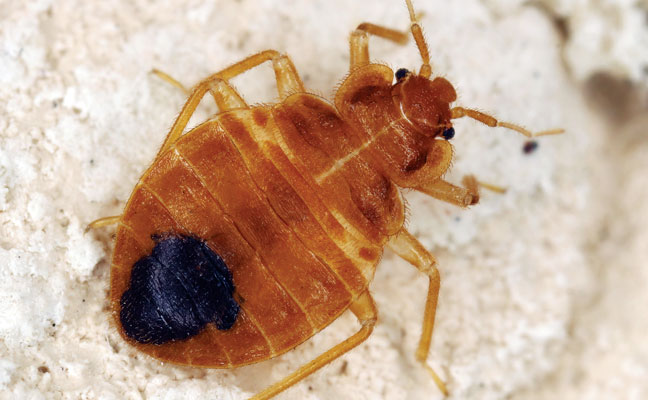
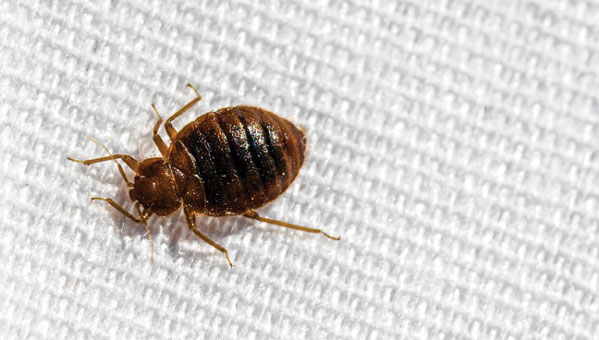
Mature bed bugs are 3/16- to 1/4-inch long. They are broadly oval, flat, brown to reddish-brown true bugs (Hemiptera), with a three-segmented beak, four-segmented antennae, and vestigial wings. They have very thin, vertically flattened bodies covered with short, golden-colored hairs.
Bed bugs give off a distinctive musty-sweetish odor, resulting from chemicals that are produced by glands in their ventral thorax. The tips of abdomens are pointed in males, but rounded in females.
Feeding only on the blood of mammals or birds, bed bugs mate by “traumatic insemination.” It may take three to 12 minutes for one bed bug to feed to repletion (or in laymen’s terms, to being full). Approximately 20 percent of the time, both adult bed bugs and large nymphs will void remains of earlier blood meals while feeding. Voiding produces rusty or tarry spots observed on bed sheets or in bed bug hiding places.
Bed bugs will travel 5 to 20 feet from an established harborage to feed on a host. Their life cycle, egg to egg, takes four to five weeks under favorable conditions (between 75 percent and 80 percent relative humidity, and 83 to 90 degrees Fahrenheit). Bed bugs can survive and remain active at temperatures as low as 44 degrees Fahrenheit, if held at an intermediate temperature for a few hours, but their upper thermal death point is 113 degrees Fahrenheit.
Bed bugs are nocturnal, but will seek hosts and feed in full daylight when hungry. Females attach small (1 mm long) cylindrical, pearly-white eggs to any nearby surface(s), generally in crevices or harborages, hiding in loose groups or clusters. Individual females lay between 200 and 500 eggs during their lifetime, which may be six to 12 months or longer. Cast bed bug cuticles tend to accumulate in harborages.
Revenge of the bugs?
This rapid and relatively sudden return of bed bugs is labeled “one of the great mysteries of entomology” by many within the field. Regrettably, and very recently, bed bugs have appeared in hospitals (the author has experienced this in his own practice), medical and veterinary clinics, nursing homes, schools, college dorms, movie theaters, dry cleaners, public housing, numerous residential homes, hotels and motels, cruise ships, taxi cabs, rental cars, and even the luggage of thousands of unsuspecting travelers.
With daily media reports of new infestations in a country fraught with tort awards, new lawsuits are increasing at an alarming rate. For example, at press time a woman was suing a hotel chain after allegedly sustaining more than 150 bites in her room, rendering her “physically scarred and emotionally damaged.”
The problem, however, is that an entire generation of PMPs has not even seen a bed bug, let alone successfully prevented or treated for them.
Bed bugs are blood obligates, usually feeding on a mammal (human, bat or bird). Bed bugs need a minimum of one blood meal of adequate volume within each life stage or instar, which allows development to the next stage — and ultimately reproduction. There are five nymphal stages, allowing each bed bug to feed multiple times if hosts are readily available.
Bed bugs appear translucent at first, but after injecting the human with saliva, containing anticoagulants and anesthetics, the bed bug turns crimson as it gorges on blood. Adult bed bugs potentially feed every three to five days throughout their six- to 12-month life span. Biting a host can cause both physical and psychological discomfort, as well as result in local allergic skin reactions to injected salivary proteins
At least 28 human pathogens have been found in bed bug populations, but have never been proved to biologically or mechanically transmit any pathogen. Shedding of viral DNA fragments in bed bug feces and the retention of Hepatitis B virus through a normal molt, however, support the possibility of mechanical transmission of disease — for example, when bed bugs are crushed onto abraded human skin.
Fighting back
A PMP’s subjective inspection is an essential part of any effective integrated bed bug program. Bed bugs must be detected and properly identified. Their approximate population size and likely harborage sites must also be noted. Cimicids that feed on bats or birds can be managed by removing those hosts and their nesting materials, amended by treating their hosts’ roosting or nesting areas.
Bed bug infestations are usually evidenced through finding live insects, dark-colored fecal deposits or rusty spots on bed linens, and within harborages. Other evidence could include discovering eggs or cast cuticles within harborages or adjacent feeding sites, or encountering the telltale scent. Combinations of two or more of the aforementioned signs tend to verify an infestation.
Document where and when the alleged victims have been bitten. Monitoring can be implemented by using sticky traps and insecticidal aerosols that bolster a flushing or excitatory effect. I’ve personally had good results in monitoring with dry ice placed in a paper cup, a heating pad, and glue trap placed in contiguous proximity under bed frames closer to the headboard.
The education of all occupants of any living space confirmed infested by bed bugs is required to ensure that perpetually active and voluntary cooperation is rendered to the management program. Occupants are expected to improve and maintain sanitation, minimize clutter, and seal harborages to exclude or inhibit the movements of the pest population load.
Assisting people in understanding bed bug biology and behavior, as well as proposed management strategies and techniques, is essential. This can be accomplished simply with verbal explanations, discovery through question and answer sessions, posting notices, broadcasting Web sites, or distributing handouts in the appropriate language. During a bed bug program, perpetual communication among occupants, housing managers, and any involved government agencies is mandatory.
Bed bugs can be vacuumed extracted from harborages and resting sites, such as box-spring edges or mattress seams. Eggs adhere to harborage surfaces and are therefore hard to extract. A high-efficiency particulate air (HEPA) filtered vacuum, removing greater than 99 percent of all particles more than 0.3 micron in diameter, will ensure that many allergens associated with bed bugs and their frass are also eliminated. Vacuuming removes a significant load of the pest population.
Additional tactics
Bed bugs have piercing-sucking mouthparts, and tarsal claws. They are incapable of chewing or clawing through a sealant or unbroken layer of paper or cloth. Therefore, sealing a layer of material in place, to completely cover a harborage opening, can impede bed bug movement.
Once encapsulated within a void or harborage, living bed bugs are effectively removed from the pest population and will die within that place. Storage of clothes and other items in plastic bags or tightly sealed containers can greatly reduce potential harborage sites.
Physical killing techniques include heat, cold, controlled atmospheres and steam. Chemical management includes crack-and-crevice applications, insect growth regulators (IGRs), impregnated fabrics and bed-nets, ultra-low-volume (ULV) aerosols, and fumigation. Designated follow-up inspections of infested sites should be conducted at a suitable interval (10 to 21 days) after each treatment to detect any evidence of continued infestation.
The epidemic of bed bug resurgence will continue to expand and challenge those within the pest management industry. But at the end of the day, the bed bug battles to come will be won by both the determination and innovation of our battalions of PMPs.