No audio available for this content.
By: Gerry Wegner Ph.D.
Seasoned pest management professionals know that carpenter ants, Camponotus spp., comprise only one genus of ants that readily excavate and displace wood as part of colony nesting behavior. Ants representing a few other genera also engage in this behavior — either outdoors in trees, logs and stumps or in the structural wood of buildings, or both.
A basic knowledge of ants that eject sawdust and other debris from their nesting and activity sites is a good thing for service technicians and pest sales associates to know before attempting to diagnose a pest problem and deciding upon a course of action with a client.
Pavement Ants
Tetramorium caespitum don’t do much in the way of gallery excavation in wood, but they do displace soil, sand and wood fragments from their activity and nest extension sites in lower wall voids and sill plates. As a result, one may notice a delta pattern of ejecta from crevices under baseboards along foundation walls and frame walls above cold joints and stress cracks in slab foundations. Likewise, streaks and piles of debris may form in crawlspaces and unfinished basements beneath activity zones in sill plates.
The appearance of ejecta piles indoors often evokes an alarm response from homeowners, most of whom fear the presence of termites in their walls. Careful examination of the ejected debris will reveal the presence of pavement ant carcasses — the evidence of necrophoresis behavior exhibited by many species of ants. If carpenter ants were present in a structure, their ejecta (or frass) would contain carpenter ant carcass fragments, such as head capsules, mesosomas, legs and gastral tergites.
Acrobat Ants
Crematogaster spp. have a reputation for occupying the abandoned galleries of carpenter ants and termites in structures. They favor damp, decaying wood siding, doorframes and thresholds, and window casements and sills. Some excavation and ejection of wood fragments from acrobat ant nesting sites in structural wood may be observed, and may result in small piles of “sawdust” similar to those associated with carpenter ants. Outdoor colonies of acrobat ants may be found in some of the same places typically inhabited by carpenter ants, such as dead trees or branches and decaying heartwood and logs.
Aphaenogaster spp.
 |
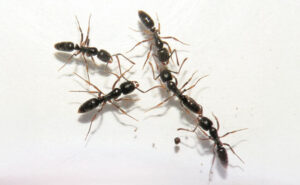
These small, glossy reddish-brown, two-node ants of the genus Aphaenogaster — particularly members of the Aphaenogaster rudis species complex (figured) and Aph. tennesseensis — excavate nesting galleries in damp, decaying wood. These slow-moving, 3/16-in.-long ants may occur in the same outdoor situations described above for carpenter ants and acrobat ants.
Although Aphaenogaster spp. are primarily outdoor ants, they have been observed trailing and foraging indoors, on occasion. They do not have a common name in North America, but in Australia they are known as funnel ants.
Velvety Tree Ants
Liometopum spp. are similar in appearance to carpenter ants (having an evenly-rounded thorax / mesosoma and one-segmented pedicel /node) and occur in the western United States. The 1/8- to 1/4-in.-long workers have been observed to nest in conifer, cottonwood and oak trees and stumps in outdoor settings.
However, one species in particular, L. occidentale, occasionally nest in the structural wood and exterior walls of buildings, where retained moisture is an issue. In such cases, trailing and foraging velvety tree ants can be observed indoors.
This species has a velvety black abdomen, yellowish to reddish thorax / mesosoma, and reddish brown head. Although velvety tree ants do not sting, they have been reported to bite people — and will defend themselves with a foul-smelling secretion containing butyric acid.
The admonition to be certain of an accurate pest identification before proceeding with a management strategy has been repeated ad nauseam. Nevertheless, I share this advice once again in hopes that no one will base his or her course of action on an incorrect guess at a causal pest, only to face embarrassment when discovered to be wrong.