
Listen to this content
In the professional pest control industry, most exclusion work holds. Sill plates, dryer vents, weep holes, utility penetrations — you seal them once, and they stay sealed because none of them move.
The garage door is the exception, and it is the reason a share of rodent jobs come back:
- It is the largest opening in the building envelope.
- It cycles several times a day.
- It seals against a poured slab that was never flat to begin with.
- The part doing the sealing is a rubber gasket, which is a wear item, not a barrier.
Every other repair you specify is permanent. This one has a service life.
I have been fixing garage doors in coastal Virginia since 2013, and the pattern I see from my side looks like this: the treatment worked; the exclusion work was correct. But six weeks later, the customer is calling somebody again because the opening at the bottom of the door was never actually closed.
The 60-second checkup
Here is how to inspect the door in about a minute, and what to write down so the fix holds.
- Close the door and kill the garage lights.
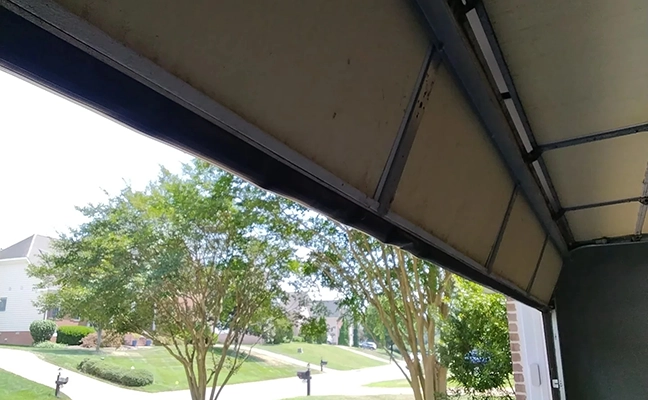
- Stand inside on a bright day and look at the perimeter. Daylight shows you every gap.
- Start at the two bottom corners, because that is where the gaps are — not in the middle where everybody looks.
- Run the pencil test. A standard wooden pencil is right around 0.25 inch. If a pencil slides under the closed door anywhere along its width, a house mouse fits. A double-A battery is a little over 0.5 inch, which puts you at your rat threshold. That is a measurement your customer can watch you take, and it ends the argument about whether the door is closed.
- Look up. Check the vinyl stop at the top corners, not only the slab.
- Note the gap size, the retainer condition and whether the door lands level.
4 common things that are actually broken
- The retainer, not the seal. The rubber bottom seal slides into an aluminum channel called a retainer. On coastal homes, that channel corrodes — and once it corrodes, it spreads. A new seal set into a spread retainer walks out of it within a season. If somebody already replaced the seal and the gap came back, this is usually why. The retainer is the repair.
- The slab, not the door. Garage slabs are poured with a pitch so water runs out, and they cure unevenly on top of that. A common U-shaped bottom seal only has 1 inch or so of real give. It cannot bridge a 0.75-inch dip in the concrete, and no amount of new rubber will. That gap is permanent until somebody adds a bonded threshold or moves to a taller bead profile.
- The door hangs out of level. Two cables lift the door, one per side. If one drum spools unevenly, the door lands on one corner first and holds the other side up. What you get is a wedge: tight at one end and open at the other. To the homeowner, the door looks shut. It is not, and no seal fixes a level problem.
- The jamb stop, not the floor. The vinyl molding running up both sides and across the header shrinks and pulls away from the frame, and the top corners go first. Rodents in an attached garage do not only come in at the slab. This one gets missed because everybody is looking down.
What to put in the report
Three lines are enough, and they change what happens next:
- Largest gap measured, and where it sits across the width.
- Whether the bottom retainer is intact or corroded.
- Whether the door lands level.
That is enough for a door contractor to price the correct repair instead of guessing. It is also enough to keep the homeowner from buying a cheap replacement seal at the hardware store, installing it into the same failed channel, and calling you back in the spring when the mice return.
An exclusion recommendation a customer can act on is worth more than a general one, and the technician who could name the actual defect is the one they quote to their neighbor. The callback you never have to make is the most profitable hour in your week.
The garage door belongs to another trade. Reading it correctly still belongs to you.