
Listen to this content
Every fall, pest management professionals (PMPs) start seeing the same thing: Phones light up with frantic customers saying, “Ladybugs are everywhere!” The pests are circling the house, covering siding, getting into wall voids and showing up indoors. Some people describe it as a “death spiral,” like something has gone wrong with the insects.
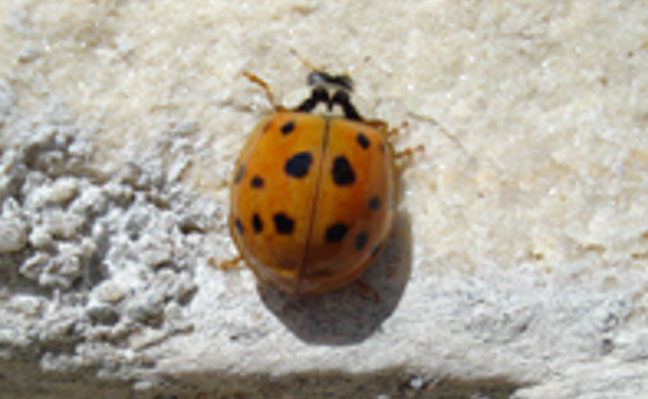
From a pest biology standpoint, nothing unusual is happening. Instead, what is being observed is a very predictable behavior pattern from a very specific species. It is not actually a “death spiral,” but a seasonal shelter-seeking and overwintering behavior that becomes noticeable when large numbers of multicolored Asian lady beetles (Harmonia axyridis) concentrate around homes and other structures.
The key to understanding these events comes back to the same basic questions PMPs use for every species:
- Where does it live?
- What does it eat?
- How do they get inside?
The species doing the swarming
The large fall aggregations that get labeled as “death spirals” almost always involve Harmonia axyridis, which is native to Asia and invasive in North America. It was released several times across North America as early as 1916 as a biological control agent, and whether through intentional releases or accidental introductions in agricultural shipments, it was firmly established in the United States by the 1990s.
Asian lady beetles are excellent predators. The larvae and adults both go after aphids, scale insects and other soft-bodied pests, which is exactly why the species has been useful in some agricultural settings.
But that is also where the trouble starts. When there is plenty to eat in the spring and summer, more larvae make it. By fall, there are simply more adult beetles in the landscape. Some stay outside. Some end up in houses. And if they find gaps around siding, windows, soffits or utility lines, they can make their way inside.
What happens in fall
As fall hits, Asian lady beetles change what they are doing. The shorter days and cooler temperatures cause them to stop feeding and start looking for shelter.
Asian lady beetles are adults by the time winter comes, and they spend the season communally. Instead of spreading out, they gather in large groups and stay inactive until temperatures warm back up. The exact purpose of these aggregations is still not fully known, but researchers have suggested several possible advantages, including helping the beetles regulate body temperature, improve access to viable mates in spring and reduce predation risk.
By contrast, native species like the convergent lady beetle (Hippodamia convergens), the spotted lady beetle (Coleomegilla maculata) and the nine-spotted lady beetle (Coccinella novemnotata) do not behave this way. They usually stay outdoors, either alone or in small groups. They tuck themselves into natural shelters like under bark, in leaf litter or in plant debris. Because they are not concentrating in large groups and they are not targeting structures, they usually do not create nuisance issues around homes.
Why buildings attract Asian lady beetles
Buildings check a lot of boxes for Asian lady beetles in the fall, but mostly because the sun-exposed walls warm up during the day, especially on the south and west sides. That heat and contrast pull beetles in. To them, a house looks like a good overwintering site.
Warmth is only part of the draw. Asian lady beetles also seem to respond to what a building looks like from the outside. Research from North Carolina State University in 2004 found that, from a distance, flying beetles may use strong silhouettes to find possible overwintering sites. Once they get closer, a sharp dark-and-light contrast can encourage them to land. That helps explain why the beetles may crowd one section of a building and leave another mostly alone. Trim, windows, rooflines, corners, siding changes and even afternoon shadows can create the kind of contrast that pulls them in.
Once they start collecting on the outside of a structure, the next step is entry. Any small gap works, most often around windows, doors, siding, soffits or utility lines. If there is an opening, they will find it. From there, they move into wall voids, attics and ceiling spaces to stay put for the winter.
The flight patterns people describe as “swirling” usually show up at this stage. The beetles are trying to orient themselves to light and warmth. Glass, reflective siding and outdoor lighting can throw that off, so they keep looping back to the same areas.
How Asian lady beetles differ from native lady beetles
Native lady beetles share a similar diet, but their behavior stops there. They do not aggregate at the same scale, they do not target structures for overwintering and they rarely enter buildings in large numbers.
From a pest management perspective, an important distinction is odor. Asian lady beetles release defensive fluids when they are disturbed. Because they congregate in large numbers. The staining and odors that can result are often what customers react to, even though the beetles are not breeding indoors or causing structural damage.
That is worth explaining clearly to customers. The beetles are not eating the house, and they are not breeding in the walls. They came in looking for a place to ride out the winter. Then, when temperatures warm up, some wake up and head in the wrong direction. So the issue is not structural damage; rather, it’s just a nuisance. Nobody wants beetles dropping into a room, crawling around windows or collecting in light fixtures, even if they are mostly harmless.
What this means for PMPs
Asian lady beetle issues are highly predictable. They follow the same seasonal timing every year, and they respond to the same environmental and structural conditions. That makes prevention far more effective than reaction.
The most important work happens before beetles enter the structure. Sealing entry points ahead of fall aggregation reduces the chance that beetles will overwinter indoors. Once they are inside wall voids, control options become limited. The resulting complaints tend to persist through winter and into spring.