Listen to this content
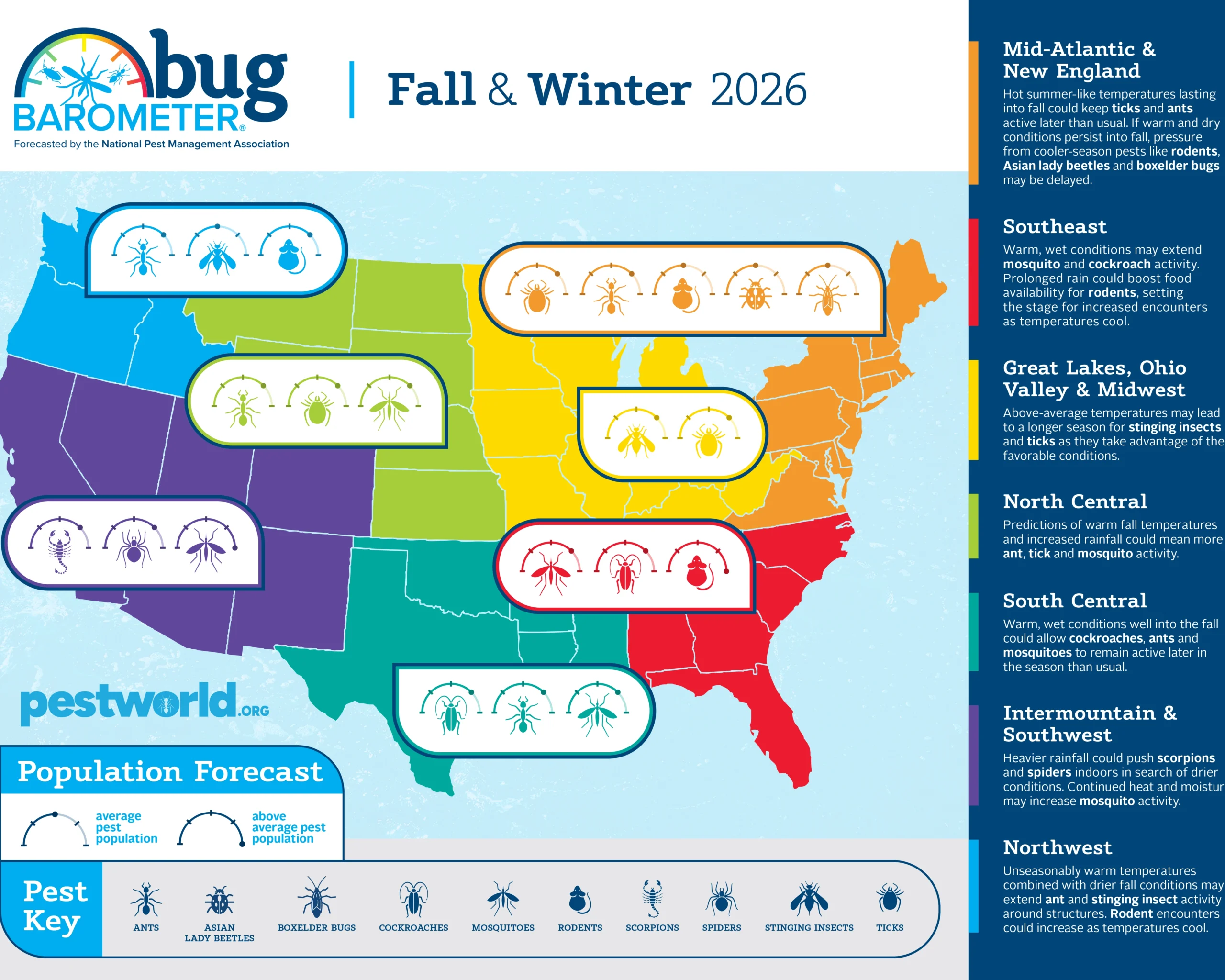
The National Pest Management Association (NPMA) has published its Fall & Winter 2026 Bug Barometer. Twice a year, NPMA’s board-certified entomologists (BCEs) examine recent weather history along with long-term weather and drought forecasts and pest biology to provide a region-by-region look at the pest activity.
Per the Fairfax, Va.-based association’s official news release, this year’s outlook points to warmer-than-average fall temperatures across much of the continental U.S., which could give pests like ants, mosquitoes and ticks more time to forage and reproduce before cooler temperatures eventually prompt others, like cockroaches and rodents, to seek shelter indoors.
“Weather is one of several important pieces in forecasting pest activity, and with summer-like temperatures forecasted to continue, pests are going to take advantage of the extra time,” Dr. Jim Fredericks, senior vice president of public affairs for NPMA, said in the news release.
NPMA’s Fall & Winter 2026 Bug Barometer predictions include:
Mid-Atlantic & New England (Maine, New Hampshire, Vermont, Massachusetts, New York, Rhode Island, Connecticut, New Jersey, Pennsylvania, Delaware, Maryland, Washington, D.C., Virginia):
Hot summer-like temperatures lasting into fall could keep ticks and ants active later than usual. If warm and dry conditions persist into fall, pressure from cooler-season pests like rodents, Asian lady beetles and boxelder bugs may be delayed.
Southeast (North Carolina, South Carolina, Georgia, Alabama, Florida):
Warm, wet conditions may extend mosquito and cockroach activity. Prolonged rain could boost food availability for rodents, setting the stage for increased encounters as temperatures cool.
Great Lakes, Ohio Valley & Midwest (West Virginia, Ohio, Kentucky, Indiana, Michigan, Wisconsin, Illinois, Iowa, Missouri, Minnesota):
Above-average temperatures may lead to a longer season for stinging insects and ticks as they take advantage of the favorable conditions.
North Central (North Dakota, South Dakota, Nebraska, Kansas, Montana, Wyoming):
Predictions of warm fall temperatures and increased rainfall could mean more ant, tick and mosquito activity.
South Central (Mississippi, Tennessee, Louisiana, Arkansas, Oklahoma, Texas):
Warm, wet conditions well into the fall could allow cockroaches, ants and mosquitoes to remain active later in the season than usual.
Intermountain & Southwest (New Mexico, Arizona, Utah, Colorado, Nevada, California):
Heavier rainfall could push scorpions and spiders indoors in search of drier conditions. Continued heat and moisture may increase mosquito activity.
Northwest (Idaho, Washington, Oregon):
Unseasonably warm temperatures combined with drier fall conditions may extend ant and stinging insects activity. Rodent encounters could increase as temperatures cool.
Previous report trends
2025: Entomologists predicted earlier and increased activity from ticks, mosquitoes, ants and cockroaches, meaning more frequent pest encounters outdoors and inside homes.
2024: NPMA expert entomologists predicted earlier and more active populations of pests such as ticks, mosquitoes, ants and others in many regions, with conditions this year likely to boost pest activity beyond typical seasonal patterns.
2023: The NPMA predicted that during spring and summer pests like ants, mosquitoes, ticks, termites, spiders and others were expected to become more common and active.
About the NPMA
The National Pest Management Association is a non-profit organization with more than 4,000 members. It was established in 1933 to support the pest management industry’s commitment to the protection of public health, food and property from the diseases and dangers of pests. The association has had many notable leaders over the years, including Pest Management Professional Hall of Famers Bill Buettner (Class of 1998), Dr. Ralph Heal (Class of 2003), Dr. Phil Spear (Class of 2004) and Bob Rosenberg (Class of 2013), to name just a few.