No audio available for this content.

LiphaTech’s TakeDown II brings double the trouble for rodents with soft bait and mini block options that provide pest management professionals (PMPs) with choices for selecting what works best against challenging rodent problems.
Featuring the active ingredient bromethalin, TakeDown II baits can be used indoors or outdoors to target Norway rats, roof rats and house mice. As an acute rodenticide, it is effective in helping PMPs “take down” anticoagulant-resistant rodent populations, especially those in a commercial setting.
The first dead rodents may appear in two or more days after a lethal dose of TakeDown II is consumed. Depending on individual customer needs, TakeDown II baits offer these additional attributes:
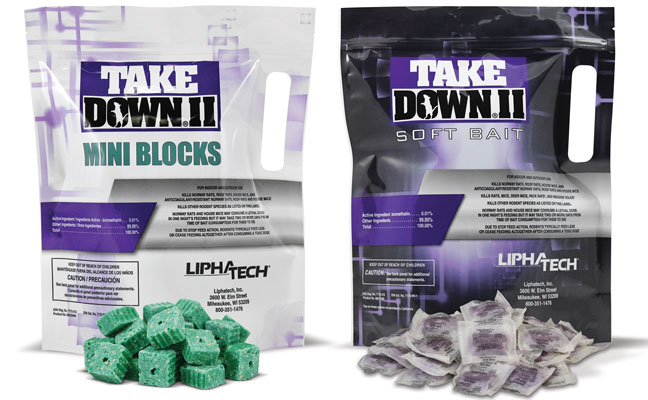
TakeDown II Soft Bait features a formula that is palatable to rats and mice. The bait maintains its integrity even in hot environments. TakeDown II soft bait is available in 8-gram pouches in 4-pound bags. It is sold by the case with four 4-pound bags.
TakeDown II Mini Blocks are designed with rodent gnawing edges and feature a center hole for securing the bait on vertical or horizontal rods in bait stations. TakeDown II mini blocks are 14 grams and available in 4-pound bags, with a case consisting of four 4-pound bags. TakeDown II mini blocks are registered in all states except Maine.
About Liphatech
With U.S. headquarters based in Milwaukee, Wis., Liphatech is a worldwide manufacturer of pest control products. It is considered to be the developer of three of the industry’s active ingredients: chlorophacinone, bromadiolone and difethialone. The company was founded in France in 1946 io develop anticoagulants for the treatment of heart patients. It developed chlorophacinone in the 1960s and branded it as Rozol, a family of products that includes grain and pelleted products for field and structural use, and a tracking powder for use in and around structures. In the 1970s, Liphatech developed bromadiolone, its original second-generation rodenticide active ingredient.
The innovations continued with the opening of its U.S. facility in 1987. Research there and in Europe resulted in the discovery of difethialone during the late 1980s, with U.S. Environmental Protection Agency registration as an active ingredient in 1995.