A new paper from Scotland’s University of Aberdeen initially arose from an entirely different experiment: researchers were originally looking to study how humidity affects social behavior in Dubia cockroaches (Blaptica dubia). While this species is not a structural pest, it is related to German cockroaches and other pest species via shared taxonomic order, Blattodea, and superfamily, Blaberoidea.
The findings of this subsequent study, published in the January 2025 issue of the Journal of Insect Science, focused on a crucial detail for researchers: whether the physical tags used to track the insects influence their natural movement.
Key takeaways from the research
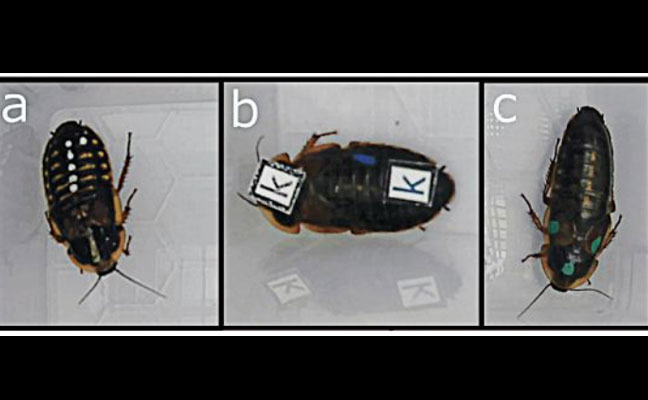
- Experimental setup: Researchers compared the movement of untagged cockroaches against those fitted with two different types of tracking tags: Radio frequency identification (RFID) tags and marker recognition tags.
- Analysis tool: Cockroach movements (speed, exploration and activity) were filmed in an arena and analyzed using DeepLabCut, an open-source AI tool that utilizes machine learning.
- RFID tags: The RFID tags did not noticeably affect the tagged cockroaches, showing similar results across all three metrics as the untagged control group.
- Marker tags: Cockroaches with marker recognition tags demonstrated significantly different behavior, moving faster, exploring more areas and being more active overall.
Tracking Movement with Artificial Intelligence
To determine whether these types of tags influenced cockroach movement, the researchers conducted two distinct experiments. In one, cockroaches were fitted with RFID tags, while in the other, they were given marker recognition tags. In both cases, some cockroaches remained untagged to serve as a control group.
The insects were then placed in a clear plastic arena and filmed from above. The video recordings were analyzed through DeepLabCut.
The researchers measured three key metrics of behavior:
- Speed.
- Exploration (how many zones of the arena the cockroaches visited).
- Activity (how often they started and stopped walking).
Comparing the tag results
The study demonstrated a clear distinction between the two tag types:
- RFID Tags: The results showed that RFID tags did not noticeably affect how the tagged cockroaches moved. They exhibited similar results across all three metrics (speed, exploration and activity) as the untagged control group.
- Marker Recognition Tags: In contrast, cockroaches with marker recognition tags moved faster, explored more areas and were more active overall.
The marker tags were of comparable mass to the RFID tags, leading the researchers to theorize that other factors may have caused this stress. These factors include the larger surface area of the marker tags, their placement on the cockroach’s body, or the extra adhesive needed to secure the two marker tags versus a single RFID tag.
Value for future research
This research is significant because it quantifies the movement differences caused by the two tag types. By establishing these effects, future research utilizing such tags can account for the changes in behavior in their methodology and analysis. This ensures that studies focusing on social behavior and movement are not inadvertently measuring an insect’s reaction to its tracking device.
About the Author

Heather Gooch is the editor-in-chief for PMP magazine. She can be reached at hgooch@northcoastmedia.net or 330-321-9754.




Leave A Comment