A power plant in Oklahoma had long been plagued with black vultures (Coragyps atratus) roosting on the steel structure over its boilers. Their numbers were increasing each year and were conservatively estimated at between 450 and 500 vultures. Their droppings were a significant problem as they created smell, discoloration and corrosion of the steel structure. They also posed a health risk to the employees.
Last spring, Predator Impact LLC was contracted for an experimental project to determine whether the vulture population could be dispersed using nonlethal methods. The Bartlesville, Okla.-based company is known for using falconry and chase dogs along with more traditional bird and wildlife management strategies.
Distribution and droppings
Black vultures are a common sight throughout their U.S. range (see Fig. 1). Northeast Oklahoma is at the northern edge of the range. The birds reside in place year-round and will migrate short distances only, if at all, which explains the year-round presence at this location.
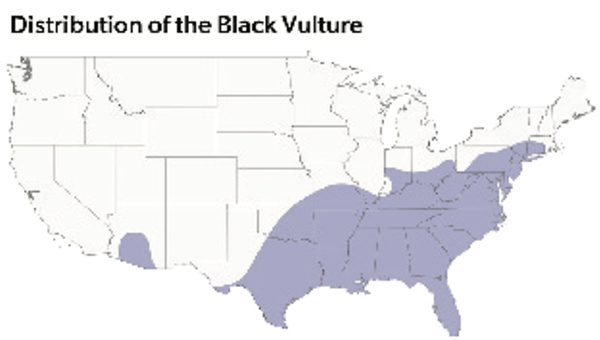
SOURCES: BIRDLIFE INTERNATIONAL AND CORNELL LAB OF ORNITHOLOGY
Black vultures are highly gregarious birds and often will roost in large numbers. They have a relatively poor sense of smell, so their primary means of finding the carrion upon which they feed is to follow turkey vultures (Cathartes aura), which are known to have an excellent sense of smell.
While turkey vultures are slightly larger, black vultures travel in packs, overwhelm the larger birds in smaller flocks, and often steal the carcasses. That said, a few turkey vultures were observed roosting with black vultures at the power plant.
While their strong stomach acid kills any diseases in the carcasses they feed on, their droppings spread a few common diseases, including histoplasmosis, salmonellosis, psittacosis (parrot fever), avian flu and occasionally cryptococcosis. In addition, the droppings smell vile, are highly acidic and leave a chalky white residue from the bones they digest. Add the fact that these birds can live up to 25 years in the wild, and roosting sites can become major long-term problems.
Like turkey vultures, black vultures are poor fliers. They will travel long distances in search of carrion, but they prefer to soar rather than flap. This requires lift from warm air rising, called thermals. This can be air rising over a sun-warmed field, black roofs or parking lots or, as is the case at this power plant, warm air rising from the cooling towers.
Abatement options
It is possible to receive a federal permit to kill up to 10 black vultures, but this was deemed to be too few to have any real effect at the power plant, and the paperwork is daunting.
After speaking with other wildlife professionals and researching the literature, it became clear that preventing the vultures from roosting, or “roost busting,” was the best chance for success in convincing them to leave the area. By denying them a calm, peaceful place to sleep, they should move to another location. This is a common, nonlethal and successful technique used to move large populations of grackles and other birds. There were plenty of options to try, but based on the logistics of the power plant and the windy Oklahoma environment, the team settled on a five-pronged approach:
▶ Certain frequencies of lasers terrify blackbirds, geese and herons. Nothing seemed to be published about whether it would work on black vultures, but the team decided it was worth testing. They selected Class IIIa 532nm <5mW green laser pointers.
▶ Drone harassment is known to be effective against geese, but again, there seemed to be no literature on its use against black vultures. Predator Impact employs a drone pilot licensed by the U.S. Federal Aviation Administration (FAA), and it decided to test the effect of the drone on the vultures.
▶ Paintball can be a very effective bird-frightening technique. It is crucial, however, to never hit the vulture with a paintball. Their bones are delicate and break easily. The noise of the gun, the impact of the paintball hitting nearby and the startling splatter are deterrent enough.
▶ Trained dogs are effective when black vultures are on the ground. The dogs cannot legally touch the vultures, but their running and barking can cause the birds to relocate.
▶ Hanging dead vulture decoys near roosts can help deter further roosting, according to literature. The team decided the best places to install them would involve leaving the catwalks and accessing the high steel areas, so the decoys became optional should the other components need them.
Initial test
Before officially implementing the project in full, the team decided to conduct a one-evening test to get a general idea whether roost-busting would work on this population.
Several years ago, the team performed an abatement job on a roost of great egrets (Ardea alba), in Oklahoma City. The project was not successful, but there was a small roost of turkey vultures that stayed in the area looking for dead egrets and chicks. When the lasers used to frighten the egrets got close to the turkey vultures, they reacted with panic. Based on this very limited information, the team decided to try the laser first.
On Feb. 3, 2025, the author and a power plant representative stood on the highest walkway above the boilers just as the sun began to set. A quick estimate counted about 450 black vultures and a few turkey vultures perched on the iron works above the boilers, or soaring above, preparing to land (see Fig. 2).
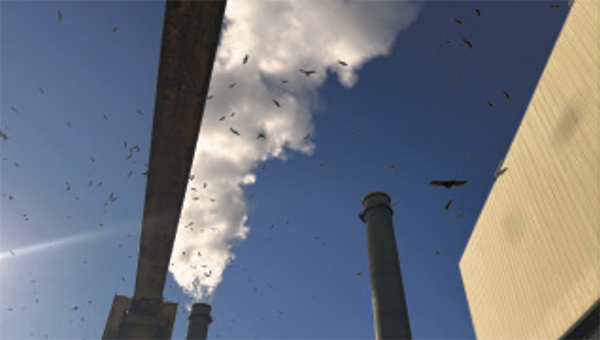
The laser was used to chase the birds as they settled in to roost. After about 20 minutes of harassing the vultures with the laser, the site was completely clean. The team stayed on-site until it was completely dark and no vultures remained.
Although the majority of the vultures returned in the following days, it was decided the test was successful enough to warrant a full-scale abatement project, with the understanding that the project was an experiment with unpredictable results. The first day of abatement was March 20, 2025.
The project begins
Because laser harassment is simple yet effective, the team decided to start with the laser and add additional treatments as warranted. Each day, the number of vultures present on the site were estimated and recorded before laser harassment.
The lasers were used from as high a vantage point as possible or against a solid backstop to minimize the laser exposure above the facility. After the second night of treatment, the estimated population was reduced by about 50 percent.
On March 22, 2025, Predator Impact’s drone pilot brought in a professional-grade quadcopter drone to test drone harassment on the vultures. Before flying the drone near the power plant’s boilers, he tested it on a group of vultures perching on nearby surplus equipment. Unfortunately, the drone proved to have a minimal impact on the vultures. When it got close, they would casually move to another perch nearby — without the expected fear response. No further drone harassment was performed.
The trained harassment dogs had a similar effect. While the two long-haired dachshunds chased the vultures enthusiastically while the vultures were on the ground, the vultures just moved to a perch out of the dogs’ reach and then ignored them.
The team continued the laser harassment, and the day-over-day population reduction continued. After a week, about a dozen vultures persisted in trying to perch above the boilers. There is an iron structure there that they could hide behind to avoid the laser.
The team brought in a paintball gun with clear paintballs. The paintballs were deliberately shot to hit the metal structure near the vultures; they never made contact with the vultures. The sharp noise of the gun firing rapidly, the sound of the paintballs hitting the steel structure, and the splatter of the paintballs proved to be the final factor in denying the vultures a roosting site. All vultures abandoned the property after the second week of treatment.
The team continued to monitor the site, but while there were a few vultures overhead looking for lift from the cooling towers, there were no more vultures roosting anywhere on-site. The project concluded on April 17, 2025.
Successful combination
The combination of the laser and paintball eliminated any vultures roosting on-site, without any need at this time to install decoys. Twelve months later, the team continues to monitor the account. Vultures continue to soar over the power plant, looking for lift from the cooling towers, but do not seem to even try to roost. If they do, the process will be repeated.
About the Author

J. Mark Runnels, PE, is managing partner of Predator Impact. He can be reached at info@predatorimpact.com.





Leave A Comment