Listen to this content
As we look toward the horizon of a new year, the pest management industry remains a landscape of diverse goals and evolving strategies. Whether the focus is on global humanitarian efforts, local business efficiency or the integration of emerging technologies, every leader has a different “North Star” guiding their professional efforts.
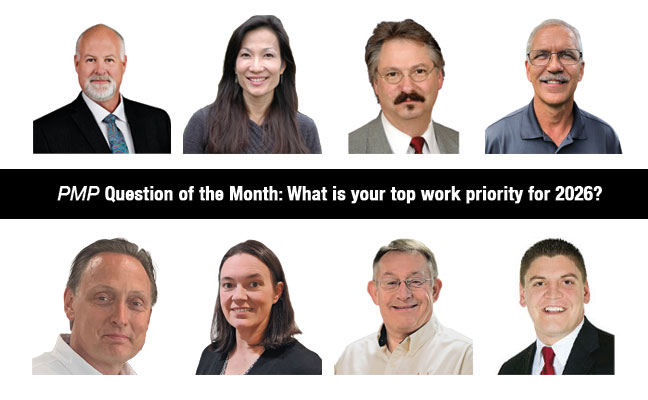
PMP asked six industry veterans and experts to share their primary work priorities as they prepare for the challenges and opportunities of 2026.
Key takeaways
- Operational refinement: Leaders are looking to simplify internal processes and cut services that no longer fit their business models to reduce staff stress.
- Technological integration: Exploring the practical applications of Artificial Intelligence (AI) and expanding online training platforms are high on the digital agenda.
- Growth and people: Maintaining a dual focus on expansion into new markets while prioritizing employee care and community giving remains a core pillar for established firms.
Global missions and digital education

For some leaders, 2026 is defined by a commitment to education and humanitarianism on a massive scale.
Dan Baldwin: “I want to solve the food insecurity problem for smallholder farmers in sub-Saharan Africa.”
Dr. Faith Oi: “I plan to provide programs to as many pest management professionals as possible, update pest identification guides, and offer more Pest Management University (PMU) online!”
Scaling sales and market expansion
Maintaining momentum requires a balance between entering new territories and reinforcing the foundation of the company — the people.
Jerry Schappert: “I want to slow down on active field work and concentrate on sales and tightening up the business.”
Eric Scherzinger: “We will continue to keep our focus on growing our company, especially in our expansion markets — as well as to continue to take care of our people and give back to the community.”
Refining the business model for efficiency
Efficiency isn’t just about the bottom line; it’s about the mental health of the workforce. These leaders are looking to simplify their operations to create a more sustainable work environment.
Doug Foster: “We are revisiting and simplifying processes in the office and in the field. That means we’re cutting services that don’t fit our business model or that we’re simply not great at. We’re also taking a second look at some unprofitable and difficult customers. We want to make life simpler and less stressful for staff and technicians.”
Mark Sheperdigian: “We want to improve our ability to change. This means recognizing where we should change, choosing the correct new direction, and implementing change so it is systemic and permanent without ruffling our workforce.”
Preparing for the spring hiring rush
Growth requires more than just more bodies in trucks; it requires a structured approach to culture and staffing needs.
Pete Schopen: “I plan to help my pest control firm clients prepare for spring hiring. Do they have written core values in place to set expectations for their new hires? Do they have interview questions ready? Have they even gauged whether they have enough recurring work to justify hiring a new employee? What is their biggest need: technician, office staff or both?”
The digital frontier: AI and efficiency
As technology moves faster than ever, PMPs are looking for ways to stay ahead of the curve through automation and quick access to data.
Desiree Straubinger: “I want to continue investigating the ways artificial intelligence can support my role, enabling me to complete tasks more efficiently and access information quickly.”