Listen to this content
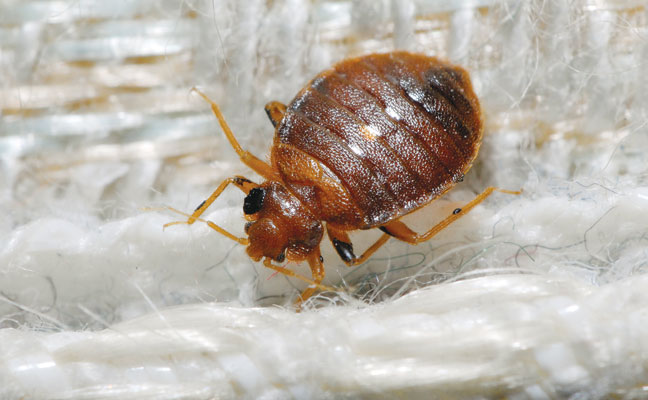
Known as one of the toughest and most dangerous parasites, bed bugs strike fear into just about anyone, especially homeowners. New research presented by UC Riverside Choe Lab researchers in the Journal of Ethology states that bed bugs may fear water and wet surfaces. UCR entomology professor and paper co-author Dr. Dong-Hwan Choe says the finding seems to make perfect sense based on the shape of a bed bug’s physique.
Bed bugs have extremely flat bodies and small respiratory openings called spiracles on their belly sides. “If they physically contact a body of water, they’ll get stuck to its surface, blocking their respiratory openings,” Dr. Choe said in a news release. “Due to its strong adhesive power, water could be very dangerous from a bed bug’s perspective. So, it’s not surprising to learn that they’re extremely averse to moisture.”
How the insight was discovered
Researchers in the Choe Lab discovered this insight by chance. Normally, laboratory bed bug colonies are kept in vials. To feed the bed bugs, the researchers attach an artificial feeder on the top of the colony vials. The insects crawl up to the top and poke their mouth parts through the membrane to ingest the blood.
One day, the membrane that holds the blood was slightly torn, and the blood from the feeder started to wet some paper used in the colony vials for the bed bugs to cling onto.
“The leaked blood was slowly soaking the paper from the top of the vial. I thought the bed bugs would be happy to drink the blood from the paper,” Dr. Choe said in the news release. “But what I saw was very different. They were actively avoiding the part of the paper that became wet with blood. They wouldn’t even walk near the wet areas.”
The researchers also wet the paper substrate in the vials with water, and the insects avoided this as well. These observations inspired further study.
When a postdoctoral researcher in Dr. Choe’s lab, Jorge Bustamante, designed some experiments, he had to use a special infrared camera with a magnifying lens. “It’s not easy to work with young, really small bed bugs. They’re maybe only 2 millimeters long or less,” Dr. Choe added.
Movement analysis via video software
Using video analysis software, Bustamante could track differences in color between the bugs and the background, allowing him to record and quantify the insects’ movements. He paid close attention to the speed and distances the bed bugs traveled to avoid wet surfaces and also examined the behavior with respect to gender and age.
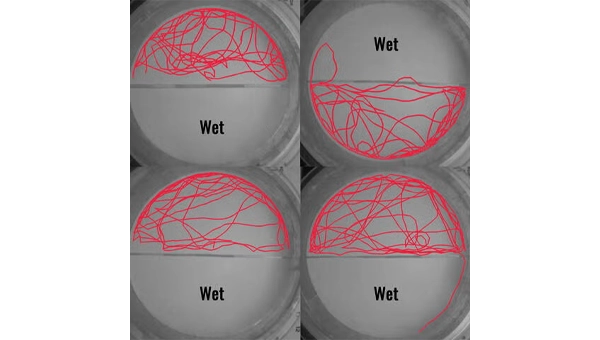
He found that all bed bugs — males, females, old and young alike — avoid wet surfaces. The bed bugs in the study also tended to flee from the water faster than they approached. However, he also saw that smaller, younger bed bugs make a faster U-turn when they realize they’re approaching a wet surface, showing the younger insects are more sensitive to water and dampness.
IMAGE: Movement traces of bed bugs in the experiment, recorded using an infrared camera under infrared illumination. It is clear the insects avoid the wet surfaces. (Jorge Bustamante, Jr. /Dong-Hwan Choe/ UCR)
Aside from the novelty of being the first to publish insights into this behavior in bed bugs, there could be some implications for treating infestations. Companies may want to pay close attention to this behavior when developing and testing water-based insecticide sprays, as the bugs will actively avoid wet surfaces created by the treatments, and possibly move to other areas of the infested property, at least temporarily.
“If the insecticides don’t kill the bed bugs right away, then they will leave the treated areas and disperse elsewhere,” Dr. Choe said. Reccomending if a person suspects they may have bed bugs on them, to “take a bath. It’ll solve the problem. Of course, the bed bugs in the room or on the bed will require different approaches.”
More from UC Riverside
35th Urban Pest Management Conference registration and details
UC Riverside study: Chemical blocks drywood termite exoskeleton formation