In the world of pest management, members of the family Calliphoridae — commonly known as blow flies, carrion flies, or blue and green bottleflies — are notorious for their attraction to “filthy situations.” However, as recent residential observations reveal, the source of an infestation may not always be a carcass, but rather a common household appliance.
Key takeaways
Sensitive detectors: Blow flies possess extreme capabilities to detect low levels of attractants, such as natural gas, via sensory hairs on their antennae.
Unexpected attractants: A faulty stove ignition switch emitting gas for only a few seconds can be enough to trigger a structural invasion.
Diagnostic protocol: When dealing with persistent Calliphorid flies, PMPs should investigate appliances for gas emissions using electronic detection devices.
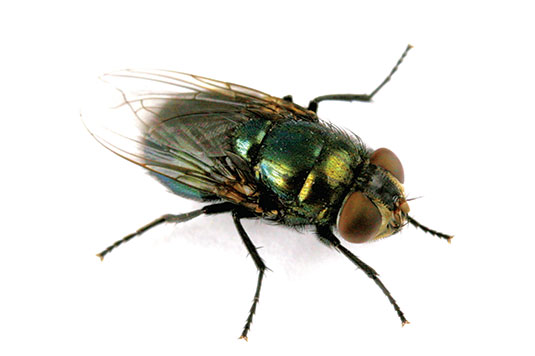
An adult black blow fly (Phormia regina). Photo: Kurt Schaefer, Texhoma, Okla.
The biology of necrophilous flies
These Dipterans commonly are referred to as “necrophilous” flies because of their attraction to corpses and dead carcasses. The larvae of most species are saprophagous (scavengers), breeding in habitats such as dog droppings, trash cans and dumpsters.
As Dr. Hanif Gulmahamad, BCE, notes, “Knowing the detestable and pathogen-filled habitats in which these flies commonly live, harbor and breed around human habitation… obviously, this makes them obnoxious invaders that are threats to human health.” Their hairy bodies serve as effective mechanical carriers for bacteria, viruses, protozoans and the eggs of parasitic worms like roundworm and hookworm.
The kitchen connection: A case study
During a 2025 home renovation, a surprising discovery was made regarding the presence of these flies. Following the replacement of old kitchen appliances, there was a “noticeable decrease in the number of blowflies invading the house.”
The investigation pointed toward a faulty stove burner. “The old stove had a burner ignition problem,” Dr. Gulmahamad explains. “We would hear a series of ‘click-click-click,’ but the flame did not turn on. It eventually would ignite after several seconds and we would smell gas.” Once the new stove was installed and the gas release issue resolved, the fly invasion significantly abated.
The role of natural gas and heat
While it is known in entomological literature that Calliphorid flies are attracted to natural gas, the sensitivity of this attraction is often underestimated. “It did not occur to him that a few seconds of gas emission, perhaps in the parts per million range, emanating from a faulty ignition switch on a stove would send blow flies in a frenzy trying to enter the structure,” Dr. Gulmahamad observes.
Furthermore, the record-high temperatures of 2025 in Southern California appeared to exacerbate the issue. Observations indicate that Calliphorid flies thrived in the baking summer heat, appearing more prevalent and heat-tolerant than the common house fly (Musca domestica).
Technical advice for PMPs
From a human perspective, it is easy to underestimate the sensory precision of these pests. Flies detect minute odors via their antennae, which are covered with numerous sensory hairs.
“This incident should alert pest management professionals that, in dealing with Calliphorid fly invasions in structures, they should look for and investigate potential low levels of natural gas emissions from appliances,” Dr. Gulmahamad advises. In cases where the source is not immediately obvious, the use of sensitive electronic gas detection devices may be necessary to pinpoint elevated gas levels indoors and resolve the root cause of the infestation.
Dr. Hanif Gulmahamad, BCE, PCA is an urban and structural entomologist and consultant based in Ontario, Calif. He can be reached at entodoc@verizon.net.
Don't Let The Articles Fly By!
Stay up to date with Pest Management Professional.




Leave A Comment