The Indianmeal moth (Plodia interpunctella, or IMM) remains one of the most persistent stored-product pests in both residential and commercial environments. Field experience and biological research consistently demonstrate that effective control is predicated on two critical actions: identifying and eliminating the primary infestation source and removing the specific environmental conditions that facilitate reinfestation.
Key takeaways
Target all life stages: Successful management must move beyond adult knockdown to intercept wandering larvae and eliminate eggs near food sources.
Prioritize sanitation: Vacuuming and the removal of silk webbing, frass, and contaminated products are foundational to nonchemical control.
Thermal interventions: Utilizing specific heat 140 degrees farenheight for one hour or freezing 0 degrees farenheight protocols can effectively eliminate all life stages.
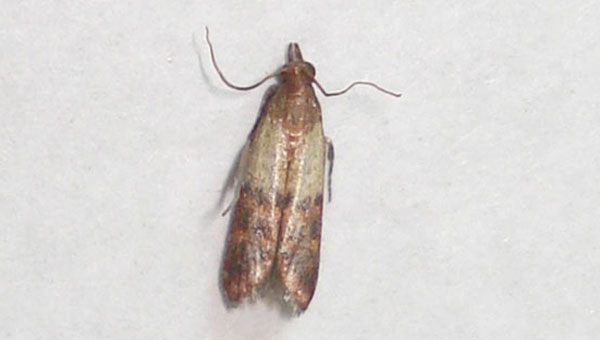
Photo: Dr. Mohammed El Damir, BCE
Accurate identification protocols
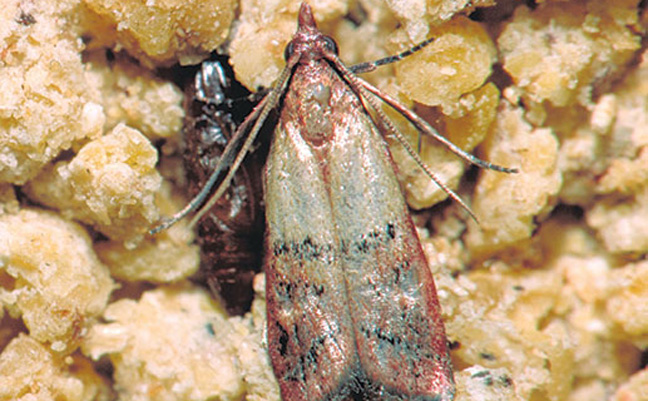
Precise identification is the first step in locating breeding sites. Adult IMM possess a wingspan of 0.5 to 0.75 inches and are characterized by two-toned forewings—pale gray at the base and reddish-brown or coppery at the outer half. Larvae, which grow to approximately 0.5 inches, are whitish to yellowish. A key diagnostic sign for PMPs is the presence of silk webbing and frass, which causes food products to clump.
Biological factors and lifecycle dynamics
Understanding reproductive potential is essential for predicting population growth. Oviposition typically occurs within 24 to 48 hours of mating, with a single female capable of laying 60 to 400 eggs. Because eggs are often deposited in microscopic cracks, seams, or folds near food, inspections must be incredibly detailed.
Larval development is strictly temperature-dependent. In warm conditions, the cycle may be completed in 27 days, whereas in cool conditions can extend this to 300 days or more. Mature larvae often migrate away from food sources to pupate in shelving or equipment, meaning non-food areas must be included in the treatment perimeter.
Sanitation is the primary nonchemical defense. Vacuuming removes larvae, cocoons, and webbing from structural cracks. For items that can be treated thermally, maintaining a core temperature of 140 degrees farenheight for one hour or 120 degrees farenheight for two hours is required to ensure total mortality. Alternatively, freezing items at 0 degrees farenheight for at least one week is effective against even cold-tolerant larvae.
Monitoring and chemical application
Pheromone traps are the primary tool for early detection and locating hotspots, while insect light traps (ILTs) serve as a supplementary tool. Because adult IMM have non-functional mouthparts and do not feed, chemical efforts should focus on residual crack-and-crevice treatments where larvae crawl or adults rest.
Space treatments or fogging may be utilized for heavy infestations to achieve rapid knockdown of adults, but these must be integrated with sanitation and residual applications. Always ensure products are EPA-registered for food-handling environments and never apply treatments directly to food.
Strategic management summary
Regardless of the specific approach, PMPs must target all life stages rather than focusing solely on flying adults. “Wandering larvae may pupate away from food sources,” making a comprehensive inspection of the entire environment necessary. By combining rigorous sanitation, precise monitoring, and targeted temperature or chemical treatments, professionals can achieve maximum efficacy and prevent population escalation.
Powell, J.A., and Opler, P.A. (2009). Moths of Western North America. University of California Press.
Covell, C.V. (1984). A Field Guide to the Moths of Eastern North America. Houghton Mifflin.
Arbogast, R.T. (2007). “Stored product insects.” In Food Plant Sanitation.
Hagstrum, D.W., Klejdysz, T., Subramanyam, B., and Nawrot, J. (2013). Atlas of Stored Product Insects and Mites. AACC International, St. Paul, Minn.
Fasulo, T.R. (2021). “Indianmeal Moth, Plodia interpunctella (Hübner).” University of Florida IFAS Extension, Publication #EENY-26.
Nansen, C., and Phillips, T.W. (1997). “A pheromone-baited trap for monitoring the Indianmeal moth, Plodia interpunctella.” Journal of Stored Products Research, 37, 231–235.
Virginia Cooperative Extension (2021). “Indianmeal Moth.” Publication 3104-1582.
National Pesticide Information Center (2025). “Pantry Moths.” Oregon State University.
Insects Limited Inc. (n.d.). “Indianmeal Moth (Plodia interpunctella).” Technical Resource Guide.eliminate all life stages, ensuring heat penetrates the core of the product.3, 7





Leave A Comment