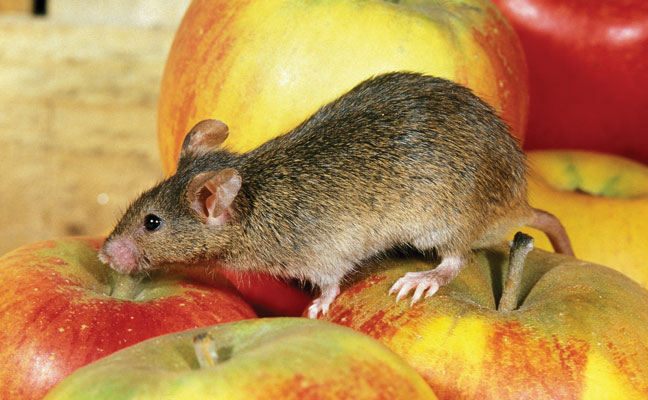
The house mouse (Mus musculus) is highly adaptive and persistent, especially in multifamily housing and commercial environments. Their small size and rapid reproduction make them difficult to control, but scientific studies suggest sustainable success requires a comprehensive, behavior-informed strategy rooted in Integrated Pest Management (IPM).
Key takeaways
- Think beyond the unit: Mice travel through utility chases and wall voids; always inspect units adjacent, above and below the reported activity.
- Behavior-guided luring: Scientific findings show that switching attractants — specifically to chocolate hazelnut spread — can increase trap captures ninefold compared to traditional baits.
- Quantify progress: Use a standardized 0–5 bait ingestion scale to track feeding activity and make data-driven adjustments to your strategy.
- Exclusion is foundational: Combining structural exclusion (sealing gaps >0.25 inch) with baiting can reduce infestations by up to 94 percent over a year.
Why isolated treatments fail
Mice rarely remain confined to a single space. Research by Sked et al. demonstrated that apartments adjacent to an infested unit are significantly more likely to have undetected activity. Furthermore, dispersal is not solely driven by food; social stress among juvenile males can trigger movement into new areas, where females quickly integrate and expand the colony.
Modern monitoring: Electronic insights
Electronic Rodent Monitoring (ERM) and field cameras reveal behavioral nuances missed in traditional inspections. These tools show:
- Actual travel routes through utility corridors.
- Preferred nesting and feeding locations.
- Behavioral avoidance of specific devices, such as mice jumping over glue boards.
Behavior-guided trapping and baiting
Effective control requires adapting to rodent behavior. One field observation by Dr. Mohammed El Damir, BCE, revealed a nine-fold increase in captures simply by switching from peanut butter to chocolate hazelnut spread.
Recommended practices:
- Test attractants: Try chocolate, oatmeal or synthetic gels at each account.
- Pre-baiting: Allow mice to investigate and mark traps before arming them.
- Strategic rotation: Alternate between blocks, pellets and soft baits to combat bait aversion.
The IPM foundation: Sanitation and exclusion
Mouse control is undermined without exclusion. In 2021, research showed that combining baiting with structural exclusion reduced infestations by 94 percent.
Recommended practices:
- Seal gaps: Use metal mesh or concrete to close any entry point larger than 0.25 inch.
- Address sanitation: Remove crumbs, dead insects and stored pet food on every visit.
Tracking success: The bait ingestion scale
PMPs should adopt a standardized scale to assess feeding activity over time. This quantitative approach helps evaluate progress:
- 0 = No feeding
- 1 = Trace nibble
- 2 = Partial bait consumption
- 3 = Moderate feeding
- 4 = Significant bait loss
- 5 = Complete consumption
The overlooked essential: Reproduction and rebound
Because mice reproduce every 21 days, long service gaps allow populations to rebound. A 2024 study by Wang et al. found that while traps and exclusion are highly effective, complaint-only programs saw infestations remain as high as 44 percent.
Technician field tips:
- Seek the heat: Inspect motors, water heaters and electrical closets.
- Detect the signs: Look for urine pillars and scent trails in hard-to-access zones like suspended ceilings.
- Winter vigilance: Activity surges in colder months, requiring year-round monitoring.
Modern mouse control demands more than just setting traps. By combining scientific evidence with professional experience — inspecting beyond the infested space, tailoring baits to observed behavior and collaborating with property managers — PMPs can break the cycle of recurring infestations.
1. Sked, S., Liu, C., Abbar, S., Corrigan, R., Cooper, R., and Wang, C. (2022). “The spatial distribution of the house mouse (Mus musculus) in multi-family dwellings.” Animals, 12(2), 197.
2. Pocock, M. J. O., Hauffe, H. C., and Searle, J. B. (2005). “Dispersal in house mice.” Biological Journal of the Linnean Society, 84(3), 565–583.
3. El Damir, M. (2025). Unpublished field observation from a commercial service account.
4. Sked, S., Abbar, S., Cooper, R., Corrigan, R., Pan, X., Ranabhat, S., and Wang, C. (2021). “Monitoring and controlling house mouse (Mus musculus) infestations in low-income multi-family dwellings.” Animals, 11(3), 648.
5. Wang, C., Sarker, S., Yu, J-J., Pan, X., Cooper, R., and Corrigan, R. (2024). “Comparing house mouse management programs in apartments.” [Study summary].
Background information: Maher, L. (2021). “House mouse dynamics in a changing climate: The Grampians National Park long-term fire and climate experiment.” Deakin University. Accessed Jan. 23, 2026: hdl.handle.net/10779/DRO/DU:27964869.v1.
About the Author

Dr. Mohammed El Damir, BCE, is technical and training director of Adam’s Pest Control, Medina, Minn.




Leave A Comment