Surinam cockroaches
The next time you’re at a home improvement retailer account, and you encounter cockroaches in the “lawn and garden” space, take the time to examine them closely. You might just be dealing with Surinam cockroaches (Pycnoscelus surinamensis).
These small, peridomestic cockroaches get their common name from a historical spelling of the Republic of Suriname, a country on the northeastern coast of South America. They are descended from Indian cockroaches (P. indicus), which are native to Southeast Asia.
Key takeaways
- Asexual reproduction: Surinam cockroaches are obligately parthenogenetic; a single nymph can start an entire infestation through cloning.
- Burrowing habits: Unlike many common roaches, this species prefers to burrow into soil, mulch and compost to feed on plant roots and shoots.
- Identification: Adults are just under 1 inch long with a shiny black pronotum and a distinct white band on the leading edge near the head.
- Moisture management: Effective control relies on an IPM approach that focuses on limiting irrigation and thinning plantings to reduce moisture.
Biology and behavior
The adult Surinam cockroach is just under 1 inch long with brown shiny wings with obvious venation. The pronotum is shiny and dark black with small punctations (spots) and has a white band on the leading edge near the head. Its legs are short and contain stiff spines.
Nymphs are solid black, with a shiny anterior (front half of the body) and a dull posterior. Nymphs are sometimes confused with beetles, but most beetles have hardened elytra (sheathlike forewings) forming a line down the middle of the back that cockroaches lack.
This cockroach reproduces asexually and is also ovoviviparous, meaning it gives birth to live young after the eggs hatch internally. A female Surinam may have between 30 and 36 offspring, usually delivered at night. The first meal of the newly born nymphs typically is the remains of their ootheca, which is expelled from the female after giving birth.
The egg-to-adult cycle takes about seven to eight months. The female adult lives about a year and reproduces continually. Males are rarely seen and are sexually nonfunctional when they do occur.
Cloning around
Surinam cockroaches are obligately parthenogenetic, which is a form of asexual reproduction where females exclusively produce offspring from unfertilized eggs. While the progenitor species (Pycnoscelus indicus) exists in both male and female forms and reproduces sexually, the Surinam cockroach is thelytokous parthenogenic.
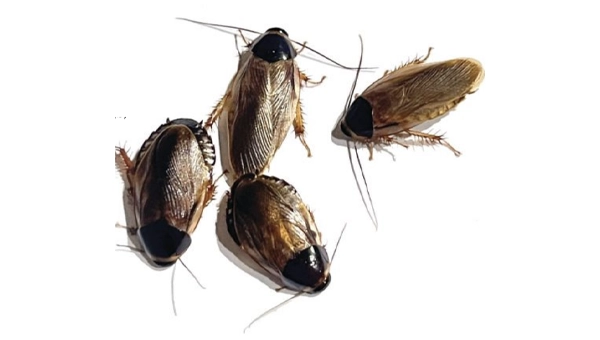
Think about it: That means a single nymph transported to a new location is enough to start an entire infestation. To demonstrate this, I once captured a nymph and set it up in a jar with some damp soil and a raw carrot for food. Four months later, I had a small colony of Surinams composed of clones of the original nymph. Asexual reproduction continued for a number of generations, with no males ever found.
U.S. distribution and habitat
Surinam cockroaches live outside throughout the southern U.S., where winters are mild. They prefer moist conditions and burrow into humus, mulch, lawn thatch and even compost piles, where they feed on the young shoots and roots of growing plants. In the southwest U.S., where arid conditions predominate, this cockroach thrives within mulch in shaded, irrigated areas because it dehydrates faster than most cockroach species.
Because of its burrowing nature and attraction to plants, this species often is transported in soil, mulch and potted plants and may become established indoors in the soil of house plants. While they rarely exist in high numbers outdoors in the U.S., in heated greenhouses, butterfly houses, zoos and mall atriums, populations can reach the tens of thousands.
Integrated pest management strategies
Because these cockroaches come out at night to feed — or even feed underground on roots — the extent of an infestation may remain hidden until serious damage is caused to plantings.
Effective control requires an Integrated Pest Management (IPM) approach:
- Moisture control: This should be the prime focus. Limit irrigation and thin out plantings to help prevent moisture buildup.
- Treatments: Sprays and granular treatments are usually effective against this pest.
- Baits: Granular baits can also be utilized as part of a comprehensive program.
The Surinam cockroach is an unusual peridomestic species. With its asexual reproduction and burrowing habits, it is a pest well worth getting to know for any technician servicing accounts with interior or exterior landscaping.
About the Author

Gilbert is the staff entomologist and technical trainer for Blue Sky Pest Control, Phoenix, Ariz. Learn more at BlueSkyPest.com.


Leave A Comment